Building the systems behind dependable botanical supply with Jefferson Shriver
by Ann Armbrecht, SHI Director
Hope, courage, vulnerability
I opened the meeting by sharing what I had just come back from: our sixth Learning Journey, in Appalachia. Three themes stood out for me from that gathering: Hope, courage, vulnerability. As Zacharia Levine said in the chat to the meeting: What a powerful three legged stool upon which we can all stand together.
For the first years of SHI, we focused on building relationships, what Otto Scharmer from the Presencing Institute, calls the social soil: the connections beneath the surface that have to be in place before anything can grow above ground. I said that this fall’s Monthly Meetings build on that soil. They are about having the open, honest conversations that help us identify what needs to change for sourcing to be resilient for everyone, from source to shelf.
To begin the series, I invited Jefferson Shriver, founder and CEO of Doselva, to frame the vision, the challenges, and some steps that can help us get there. Doselva is a supplier of organic spices that works with smallholder farms in Nicaragua and Honduras.
What resilience looks like
Jefferson began with an important distinction: steps that make a brand more resilient, or help it manage its own risk, do not necessarily reduce risk for the supplier. A buyer who shifts away from a difficult origin protects itself but leaves the origin exposed. Resilience at origin is something different, and the first step is for buyers to see the difference.The pressures on origin are real and ones we all know well: shifting political and economic conditions, including tariffs, governments and treaties that do not always deliver what they promise, and regulations that don’t necessarily achieve what they were meant to. There is environmental disruption (climate, pollinators, habitat loss), geopolitical unrest, and migration from rural areas to cities.
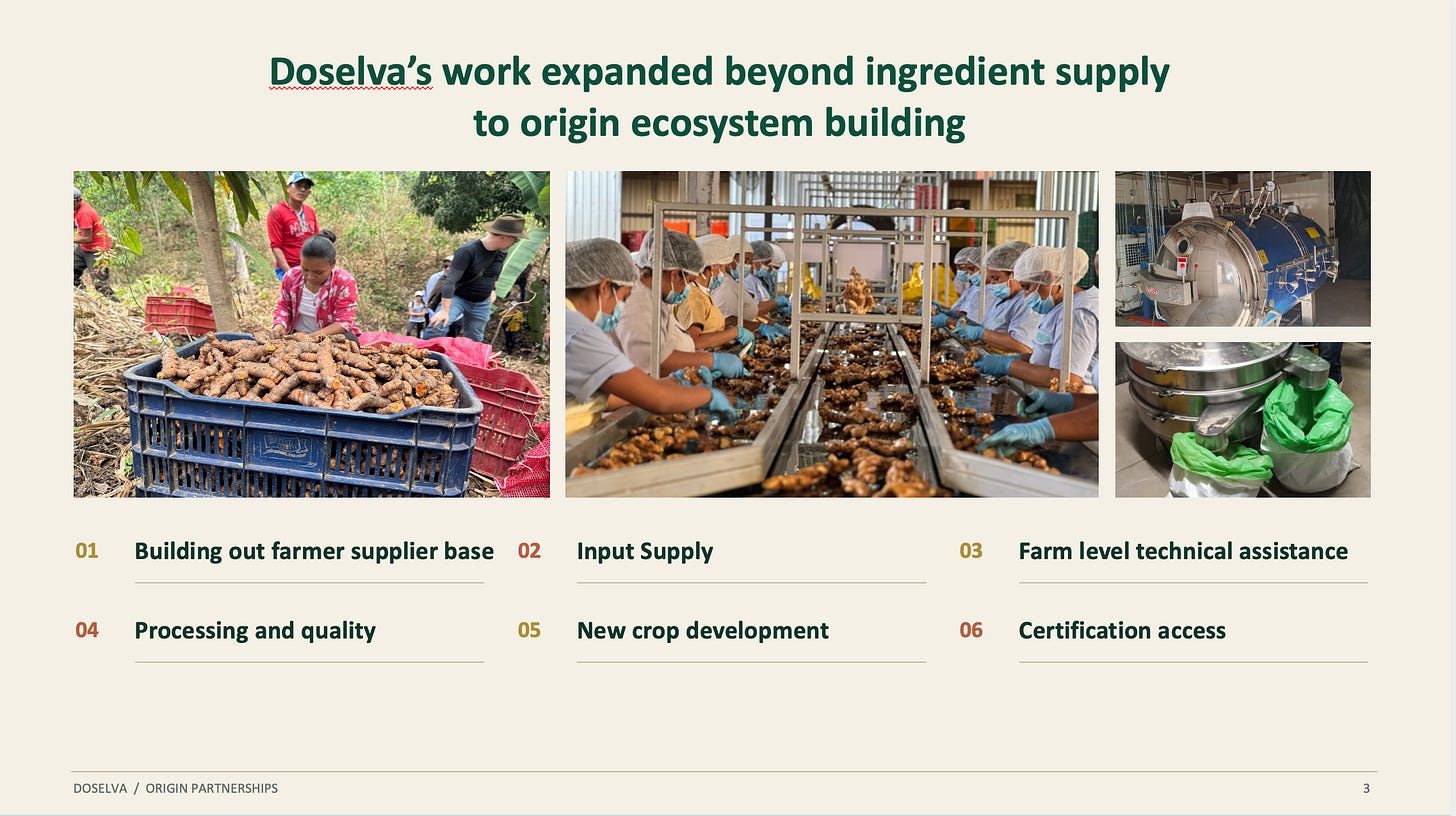
Origins that are resilient are better set up to manage these pressures. When things get tight, challenges are hard to navigate, and resilience helps ensure that the people trying to do the right thing can actually do it.This asks us to change how we define success. Jefferson described the goal as becoming an origin ecosystem builder. That means moving from getting the quantities we need at the price we need to seeing that the whole ecosystem at origin is resilient enough to deliver under pressure.
Delivering Under Pressure
- Economic viability. The people on the ground can stay engaged and reinvest.
- Diversity. No single crop, buyer or facility carries the whole system.
- Aligned relationships. Partners share visibility, risk and value, and they value what they are doing.
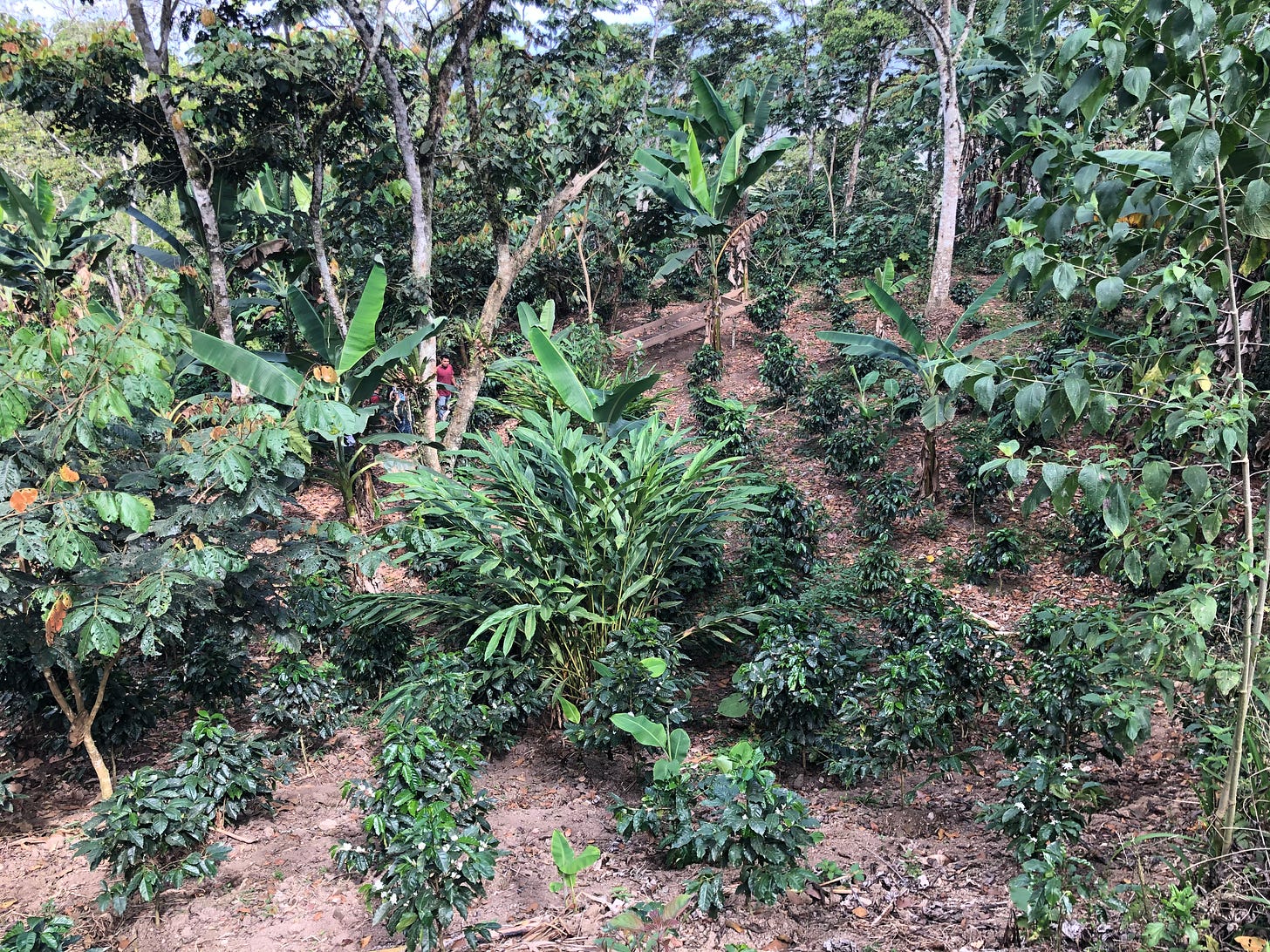
- Local capability. Knowledge and operating capacity stay close to production. Jefferson called this key to a resilient origin.
- Shared information. More transparency and knowledge sharing about best practice, with fewer silos.
- Capacity to adapt. The system can finance change and respond quickly.
Jefferson was clear that building resilient origins is not philanthropy. Every supplier faces climate and crop shocks, contamination and compliance events, price volatility and farmers leaving, and failures in infrastructure and logistics. The practices apply at every step in the value network: diversify, build skills at each level, and keep enough of a financial buffer to weather a tight spot.
The business case
A strong origin can recover quickly from a shock without being abandoned. It can take corrective action on quality and compliance in a transparent way. Because of that, it can adapt, developing new crops and keeping methods and specifications within reach. And it gives the buyers who work with it more credibility in the system.
We need to get these stories out more, because most actors who are not at origin do not really know what is going on.
Scavengers and replenishers
While Carol was talking about replanting seeds, not taking too much from any given stand, her words also apply to building relationships. On the final morning of the 2026 Learning Journey in Appalachia, the Asheville Tea Company team talked about how their vulnerability and openness, after Hurricane Helene, led to all sorts of relationships that have carried them through everything they have faced since. CEO Jessie Dean said she never would have known how much people care if the company’s building had not been washed away. In a way, that is the business case for vulnerability. When you show up and others know you care, they show up for you.
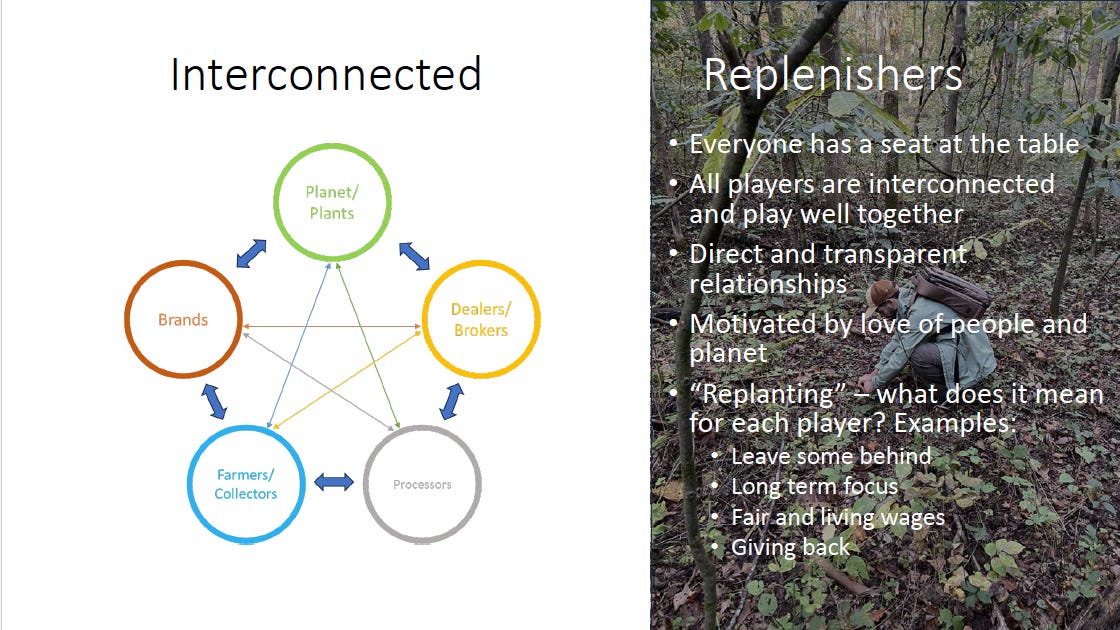
During our first Learning Journey in Appalachia, herbalist Lori Briscoe said the old game is not working for anyone, and that we learn the new game by walking together.
That is what we are trying to do at SHI.
What partnership looks like
Awareness is the first step, and it often arises on Learning Journeys. The harder question is what happens back at the company: whether it acts and begins to partner with suppliers differently. Jefferson said real partnership has to include co-investment. We have to put our money where our mouth is, and that means more than financial resources. He described several forms it can take.
- Market commitment. Some predictability: a forecast shared well in advance, a minimum volume, and visibility into premiums for value added at origin. Doselva has signed up for ROC (Regenerative Organic Certification) but does not really know what the market response will be.
- Knowledge sharing. Customers can see what is happening with suppliers in other parts of the world, from best practices in processing to the type of machine. Sharing that information is critical.
- Shared projects. Living income studies and investments in farms and processing facilities, which have more of a grant function.
- Financial services. Equitable payment terms, joint ventures, and equity in an origin partner. Doselva has bootstrapped its approach, Jefferson said, and this has worked for the first 8 to 10 years, but it is no longer enough. Strengthening origin takes more investment than any single investor can make, and venture capital does not fit. This is where supply chain partnerships can come in, with some vertical integration: partnering with an origin partner, not buying it out and not merging, but coinvesting.
- Innovation trials. New crops carry risk. Should a company like Doselva carry that alone, or could knowledge sharing let us run those trials together?
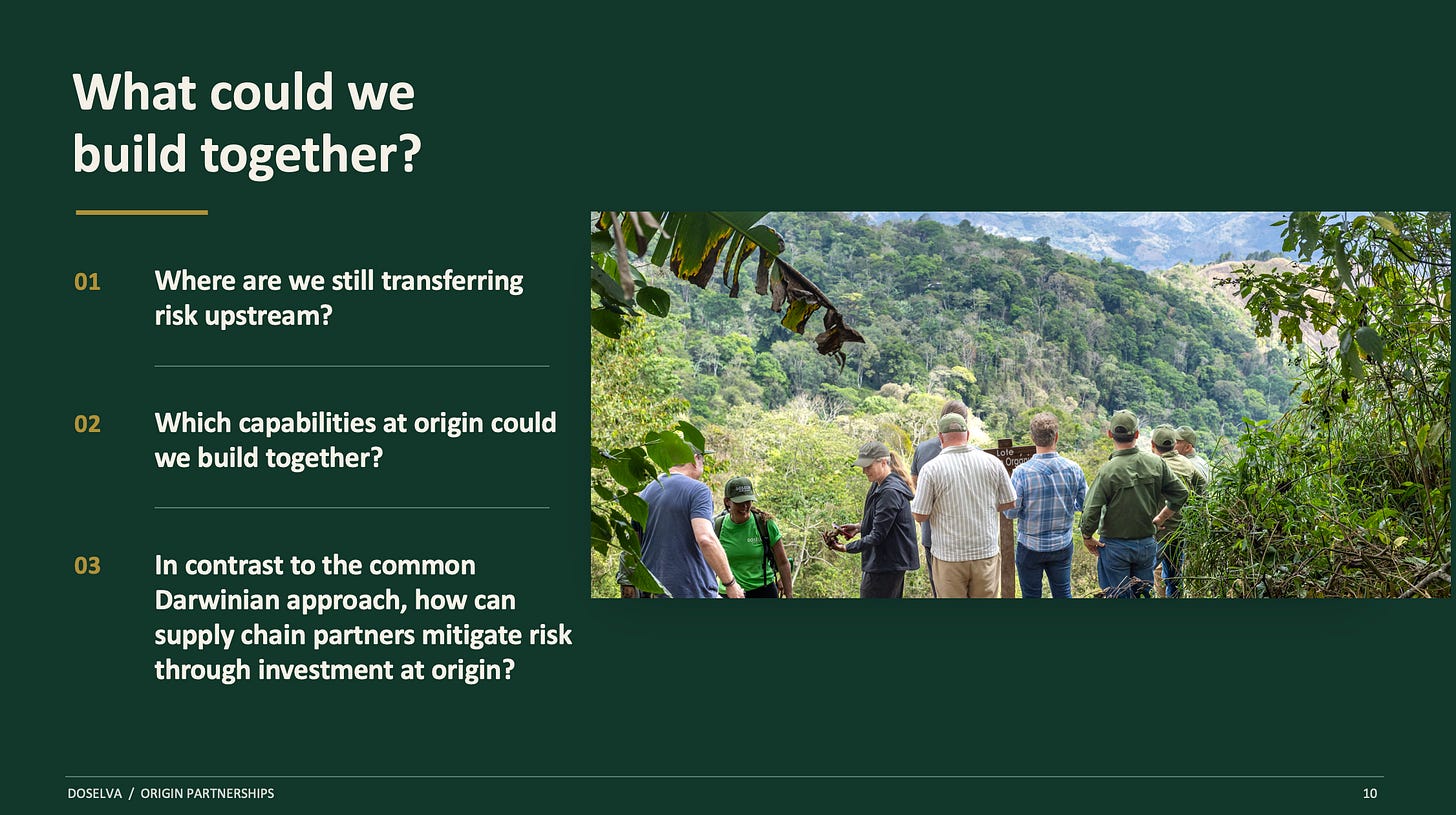
Slide from Jefferson’s presentation
When something goes wrong
Jefferson said he is not assuming that all the risk sits at origin. There are risks further down the supply chain too, but origin is where he can speak from. Risk allocation becomes visible when something goes wrong.
- Contamination. Pesticide residues can show up even in organic supply chains, despite certifiers, internal audits and lab testing. When it happens, there should be agreed protocols so that the cost of the lot does not land only on the farmer or supplier. Doselva is developing conventional partners for products that get rejected and has had to isolate farmers and lots when cross contamination happens or one farmer does not follow the rules exactly. These are difficult conversations to have with partners.
- Failed specifications. When a lot fails customer specs, the origin partner needs the equipment to fix it. Doselva has recently been able to invest in steam sterilization.
- Cash flow. Farmers need cash at the right time, which matters more than price when people live day to day. Some partners tell Doselva they are not a bank and cannot give advance payments. But they can introduce a financial service provider and build the cost of financing into the price, which shares the risk.
- Certifications and access. Certifications are a large part of Doselva’s markets, and the company holds seven, each at a cost. How do you decide which to invest in, and what is the return? Jefferson also showed a slide of the barge that carries ginger from the place where Doselva sources 90% of it, a place with no bridges. Every visit, delivery and inspection carries the cost of reaching that region.
Who pays?
Questions to ask
- At each step, am I scavenging or replenishing?
- What would it take for a supplier to tell a buyer about a problem before it becomes a crisis (see the Sourcing Relationship Health Assessment in the SHI Toolkit 3.0 for a framework to assess the health of your relationships with suppliers)?
- If a lot fails or a shipment is rejected, who pays? Have we talked about it before it happens?
- Does the way I buy reduce risk for my supplier, or only for me?
This was the first conversation in a fall series. In October, speakers from UEBT, Fair for Life, the Regenerative Organic Alliance, and Fair Wild shared how certifications fit with these questions. In November, seven speakers from six companies gave concrete examples of putting these ideas into practice.Reach out if you’d like more information on joining the Sustainable Herbs Initiative!