Climate Change and Nepal
I’ve had a draft of this newsletter in my in-box for a few weeks. In that time, the devastating tsunami-flood occurred in Nepal and Tibet and I haven’t much felt like coming back to finish up a newsletter.
This one hits hard. Like so many, I’ve spent formative years of my life in that part of the world. And so there is the actual devastation, the loss and destruction and the ferocity of that onslaught of muddy water plunging through the river valley on video after video that I’ve pored over because it feels important to bear witness in some way.
And then there is the fact that we have been warned. People have known this would happen, they’ve been warning about it for years. It turns out that proposals for early warning systems didn’t get funding (Bill McKibben writes about that in his recent newsletter). Whether or not that could have made a difference, we’ve known that a warming planet creates the risk of this type of flood. The leaders who could turn things around have known that. Leaders of businesses. Leaders of countries. Leaders of the tech wave that seems to be taking us even deeper into more of these impacts.
It’s that sense of powerlessness maybe that cuts the deepest. If nothing else, it makes me buckle down even more on the work we are doing at the Sustainable Herbs Initiative. And so I’ve been thinking about how to bring more urgency to our work without losing the attention to presence and listening to the plants, because the place from which we act matters.
Below are some highlights from what we’ve been up to and what is coming.
Thank you, as always, for reading.
Registration open for 2026 Learning Lab

This fall, SHI is offering a new Learning Lab (register here) that brings the practical skills and practices of the SHI Toolkit 3.0 on Ethical Sourcing in the Herbal Products Industry into a virtual series where we explore not just how to do this work, but why certain practices matter and what shifts are needed across the industry to support them.
Over four sessions, we’ll work with SHI members and guests to build: practical skills to use immediately, awareness based systems level thinking, and relationships with peers also engaged in this work. Central to all of it will be practices of deep listening, paying attention to the unseen, and connecting with the plants and the people in your supply chain as whole beings. If you are interested, you can find more and join us here.
Learning Journey in Appalachia
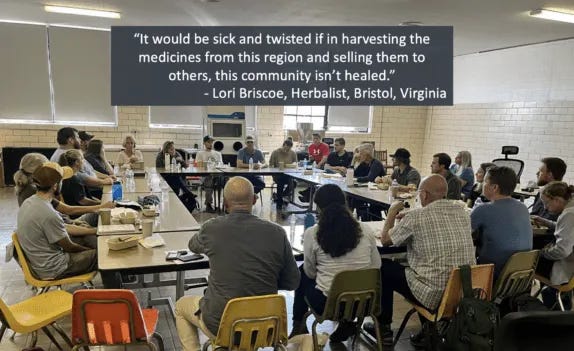
The next SHI Learning Journey happens late this September, returning to Appalachia, which is where we held the first SHI Learning Journey in 2023. This Learning Journey will bring a larger scope, beginning with a day in northeast Kentucky looking at an initiative to restore abandoned coal mine lands through forest botanicals (with Renew Appalachia and John Munsell from Virginia Tech). We will visit the Forest Botanicals site outside Norton, VA and the Appalachian Herb Hub in Duffield, VA. We will then spend the next two days exploring themes of growth, scale, and right relationship with the earth with visits to the Gaia Farm, the Mountain Horticultural Crops Research and Extension Center at NC State, Asheville Tea Company, and Kestrel Farm.
Note: SHI Learning Journeys are immersive, place-based gatherings that invite industry leaders to engage directly with the landscapes, communities, and ecosystems most affected by sourcing decisions. Participants slow down, listen deeply, and connect as whole people.
Previous Journeys in Appalachia, Oregon, and Nicaragua have catalyzed transformative shifts in mindset and practice, inspiring more thoughtful, accountable engagement with supply partners and ecosystems. You can read about those experiences here. We have already begun planning two Learning Journeys for 2027, one in Colorado in June and another in India in November. Reach out to become an SHI member if you’d like to join us!
Recent SHI Blog Posts

- Why Plant Journeys Matter at SHI: We begin SHI Monthly Meetings with a plant journey. I reflect on why that matters here.
- Self-Assessment for Sourcing Herbs: This assessment is a great place for companies to begin diving into their sourcing practices. It’s also a great source of questions to ask companies who’s products you buy to see how much they know about where their herbs are from.
- SHI’s AI Policy: Like many, I’m extremely ambivalent about AI. I created this policy after a presentation by Jane Franch on the Responsible Use of AI for SHI members. It is a work in progress that we will continue to update and modify as we learn more.
SHI in the News
- The visible and the invisible. (An SHI Learning Journey in France) – David Gordon once again writes so thoughtfully and generously about his experience of our Learning Journey in France this past May. His closing words are so beautiful, they are worth sharing here:
“Zacharia Levine of The Pure Synergy brand of supplements describes the learning journey as a model for learning, a way of seeing. Are we here to study plants? Yes. Are we here to see l’Herbier’s operation? Yes, wonderfully so! Are we here to learn from each other? Yes. These are the tangibles, the seen. Yet Zacharia points out that we are also learning to see with fresh eyes, to see what we haven’t seen in the past, to rethink what’s possible. To see the visible and the non-visible, to engage in the physical as well as the metaphysical. To experience thin places. To be part of a rag-tag group of herbalists, farmers, and processors in a time of transition. To feel pride as we move from the harsh neglect of Mother Earth to one that celebrates those who nourish the land, who are willing to do the hard work of farming. Is there anything more important than being a steward?
In our voices I hear pain. The many challenges of survival. The lack of proper wages, profits that come and go. One might challenge any of us that we are pipe dreamers, that the big has already prevailed. Yet we know that not to be true. For all around us, we see faces like ours. Staying the course means real concerns are visible. Who will wild harvest when this generation of wild crafters pass? Who will farm as land increases in price, machinery is ever more expensive, interest rates are high, and the climate is changing. Yet here we all are – and I have never been more excited by the possibility.” David Gordon, read the whole post here.
- Learning Journey with Motherlove: I was invited to lead a session for the first day of Motherlove’s annual staff retreat. I love their write up of that time and how SHI wove into their work.
What I’ve been reading
- Two Ways of Knowing: How Merging Science & Indigenous Wisdom Fuels New Discoveries: I loved this conversation on the podcast, The Great Simplification, between show host Nate Hagen and Rosa Vásquez Espinoza, Peruvian chemical biologist with Andean-Amazonian indigenous roots.
- Will Rozensweig: Crafting A Positive Impact Food System: I was so inspired by this conversation between Dave Chapman, of the Real Organic Project, and Will Rozensweig, founder of The Republic of Tea among many other things, that I reached out to Will (whom I didn’t know) to ask his advice on how to grow our work at SHI. That conversation inspired my recent post, What Does Success Look Like.
- Special Coca Issue: A Compelling Case to Reconsider Coca and Its Role as a Health-Promoting Botanical: The American Botanical Council has devoted a special issue of HerbalGram to the too-often maligned and under appreciated herb coca. Read more here.
Ways to Support Nepal
- SHI Program Assistant, Keshari Das, shared this information on Mountain Heart Nepal: One of their partner organizations is US-based Direct Relief, which has an A+ rating on CharityWatch (an independent charity watchdog org). According to Direct Relief, “Mountain Heart Nepal, which connects medical care and outreach to the country’s hardest-to-reach areas, is receiving an emergency operating grant to support emergency medical teams deploying into flood-affected communities. Those teams are equipped with Direct Relief field medic packs that were pre-positioned in Nepal before the flood.” Find out more and donate here.
- Particip-Aid: SHI member, Erin Willis is doing remarkable work in rural Nepal (including the recent publication of a booklet: Indigenous Medicinal Plants of Nepal, published in Nepali and English) and previously worked in the region of Nepal most directly impacted. They have a donor willing to match the funds they raise for flood relief dollar for dollar (until Sept 3rd). Find out more about this work and how to support it here.