Reflections from the Final Session of the Primary Processing Learning Lab
By Ann Armbrecht, SHI Founder and Director
We use the word “partnership” a lot in the herbal industry. It sounds good. It signals that we care about more than transactions. But what does it actually require: day to day, contract to contract, hard conversation to hard conversation?
That’s what we explored in the third and final session of the SHI Primary Processing Learning Lab, with Ellie Thorne of Blue Sky Botanics and Matt Richards of Organic Herb Trading (OHT). Both companies have built their models around long-term sourcing relationships with smallholder farmers, collectors, and processors. And both were refreshingly honest about what that actually looks like, including the parts that are uncomfortable.
The recording is available for SHI members. Here I want to pull out some of what I found most useful and most worth sitting with.
The Central Insight: Quality of Relationships, Not Certifications, Is the Foundation
One thread ran through everything Matt and Ellie shared: the health of the supply ecosystem depends on the quality of the relationships within it. Certifications are a useful tool. But they don’t replace trust, presence, and genuine mutual accountability. The strength of a system isn’t defined by its certification level but by the quality of interactions between the people who make it up.
That might sound obvious. But it has real implications for how we spend our time, what we prioritize, and how we think about risk. If relationships are the foundation, then investing in them isn’t a nice-to-have. It’s the work.
How They Think About the Supply Ecosystem
Matt laid out how their different roles in sourcing:
- Growers, collectors, and primary processors are where 95% of quality is determined. The soil, the practices, the knowledge, the drying, all of it happens before a trader/buyer ever sees the plant.
- OHT’s role, as he described it, is to represent the collectors, growers, and processors, to advocate for them and for the plants and land that form the basis of everything downstream.
- Blue Sky Botanics sits further along the chain, manufacturing liquid extracts. Ellie described a dual translation role: making the realities of the field legible to brands and customers, and making the needs and expectations of brands legible to suppliers. That translation work, she said, is a huge part of what they do.
- Brands and customers sit at the end. Blue Sky works to translate the complexity on the ground to their customers.
This framing: supply ecosystem rather than supply chain, matters. A chain suggests linear extraction. An ecosystem suggests that the health of each part affects all the others.
What Partnership Actually Requires
Both Ellie and Matt were specific about what they look for in a sourcing partner and in their relationship with each other. Not vague commitments to sustainability but actual practices and orientations:
- Fit and alignment.
There’s a formal layer: questionnaires, payment terms, checking that you’re aligned on basic operating principles. But there’s also something you sense quickly. Do you share the same goals? Are you willing to be honest with each other? How is the fit?
- Attention to power dynamics.
Matt was direct: they aren’t looking to accumulate power or assume they know better than their partners. He’s been in situations where a customer thinks they know best and isn’t willing to hear about the reality on the ground. That dynamic is quite prevalent in the industry, and it’s one they actively work against. There’s a historical dimension to this too. In a supply network where the people carrying the most weight and the most risk are often seen as having the least power, understanding those dynamics and actively working to change them is part of the responsibility that both OHT and Blue Sky Botanics take seriously.
- Time and commitment.
Spot-buying means learning something new every time. Long-term relationships mean you face the same challenges: crop failures, climate volatility, quality issues, economic hardship, together, year after year, and each time this gets a little easier to navigate. The conversations that were uncomfortable the first time become easier each time you have them. That allows you to move more quickly to the nitty gritty of addressing the challenges. That’s not a small thing.
- High mutual expectations.
Partnership doesn’t mean letting things slide. Accountability to meeting high quality standards is key, and that accountability is part of what makes the relationship worth having. The goal is to be raising the bar together.
- An ecological rather than extractive orientation.
Matt used the distinction between cooperation and competition, between contributing to the health of the ecosystem versus extracting from it. A healthy ecosystem, he said, makes the ground more fertile for the next person. That’s the model they’re trying to embody.
The Role of Trust — and What It Makes Possible
In a real partnership, they both shared, asking for support is a strength, not a weakness. When you’re in an early-stage relationship, admitting you don’t know something or need help can feel like exposure. But in a strong partnership, it’s just how learning happens. “Every day is a school day, but you don’t have to be taught by the same teacher,” Ellie added. The best learning often comes from outside your own echo chamber, from being genuinely open to what your partners know.
That kind of trust also changes how you listen. Ellie and Matt both described listening not as extractive, not just gathering information, but as creating genuine exchange. It requires being fully present, reflecting back what you’ve heard, and moving forward from that point together. Context is everything, she said. Without it, expectations don’t get met and things can get lost in translation.
The Real Challenges — And How They Navigate Them
They weren’t shy about the hard parts:
- Price conversations are the toughest. They hinge on the question of like not being like.
A core challenge that everyone producing and sourcing herbs will recognize: you can have two certified organic products that are not the same thing, and the buyer, looking at a spreadsheet, will compare them by price.
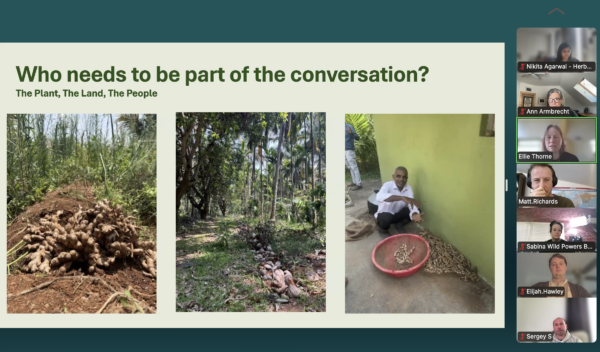
Take ginger. Ginger from a large monocrop farm has a certain type of employment, a certain relationship with the soil, a certain interaction with the surrounding environment. It may meet minimum organic standards, but that’s a floor, not a ceiling. Ginger may also be grown by a smallholder family on a plot in Kerala or Nicaragua, in an agroforestry system, where the farmer is thinking about biodiversity, about the wellbeing of the family, about the ecological context of what they’re growing. The quality is different. The crop is different. The context is entirely different.
On paper, a buyer sees two certified organic gingers. One is cheaper. And a huge part of what both Ellie and Matt do is explain why those two things are not equivalent. Why the price difference reflects a difference in what the product actually is, where it comes from, and who it supports. True transparency, they both said, is what allows you to advocate for that difference. Without visibility through OHT to the growers, understanding what they’re actually doing and why, Blue Sky Botanics can’t have that conversation with customers. The information has to flow both ways for any of it to work.
- Certifications don’t replace relationships.
Certifications are a tool in the box, but nothing replaces being on the ground, knowing the place and the people.
- Important to apply brand sustainability targets to the context.
Every supply network has its own context. Every conversation and sustainability target like reducing carbon emissions needs to be tailored to that context. If your goal is positive impact, Ellie said, you need to frame it in ways that are meaningful to the people you’re asking it of.
- HACCP and food safety standards benefit from dialogue, not just compliance.
Health and safety standards look different in different cultural contexts. The goal isn’t to lower standards, but to understand what risks actually exist and calibrate expectations accordingly, rather than demanding compliance with standards that don’t reflect the actual risk profile.
Practical Tools That Actually Help
- The seasonality calendar and forecast windows.
Both Matt and Ellie talked about the value of tools like a seasonality calendar and seasonal contract windows. This is a way of making customers honor the reality of agricultural time. If you want the ingredient, you need to understand and respect the process that produces it.
- Getting brands into the field.
Both Ellie and Matt described bringing brand representatives on supplier visits as one of the most effective tools they have. Once someone has stood in the field and seen the reality of what they’re asking for, the conversation changes. It is important to frame these visits as educational opportunities for brands, not to enforce compliance.
- Collaborative meetings and shared vision.
Annual alignment meetings, supplier visits, and collaborative customer conversations aren’t just relationship maintenance. They’re how you build the understanding that makes hard conversations possible. Connecting as people, having fun, lacing shared values into how you work.
The Ripple Effects
Their goal is to support smallholder farmers and to make it possible for products from otherwise marginalized farmers to reach markets in Europe. That’s a real and significant thing. Not every company can make those sourcing choices.
I asked, in a commodity-driven market, how many companies are actually interested in this kind of deeper relationship? And what gets in the way? Matt’s answer was honest. People come to OHT for a reason. They aren’t the cheapest option, and customers who find them are usually looking for something more. But cost conversations are a reality, especially as companies grow. Ellie said she’s seeing a genuine increase in companies holding themselves to higher standards, and consumers asking for more visibility and transparency. The challenge is taking those intentions deeper than surface level, past the questionnaire, past the certification, to a real understanding of and commitment to what is happening on the ground. Both the difficulty and the opportunity are real, and they sit alongside each other.
The more connected everyone feels to the supply networks, where things come from, the more they will start to care, Ellie said. When you start to care, you pay attention differently. Your commitment increases and you get that longevity that is so important.
And so the challenge then becomes how to share that understanding with people who haven’t had that experience. How do you help someone care about something they’ve never touched? That’s a significant part of what they are trying to do — not just source well, but bring others along, so that the responsibility and the care get distributed further up the chain toward the brands and consumers who are, in many ways, the ones with the most power to change things.
Action Steps — If You’re Ready to Go Deeper
- Answer the question “Why wouldn’t I just buy the cheapest?” for yourself first, then for your customers. A participant in the Learning Lab described this as an opportunity to start a positive feedback loop. Being able to answer it means you need to learn about your suppliers well enough to advocate for the value they bring.
- Audit your forecasting process. Are you passing demand pressure and uncertainty down the chain — to the people least equipped to absorb it? If so, consider contract windows and volume commitments tied to agricultural timelines.
- Consider visiting your suppliers. Or, if that’s not possible, facilitating a conversation between a brand partner and a grower. The understanding that comes from being present is hard to replicate any other way.
- Reflect on your relationship with certifications. Are you using them as a tool alongside trust and direct knowledge? Or as a substitute for them? There’s a difference and it matters.
- Be honest about power in your supply relationships. Who carries the most risk? Who has the most power to set terms? What would it look like to actively change that?
The SHI Primary Processing Learning Lab was designed for farmers, wild harvesters, primary processors, ingredient suppliers, and wholesale traders. We’ll be announcing future programs soon.